
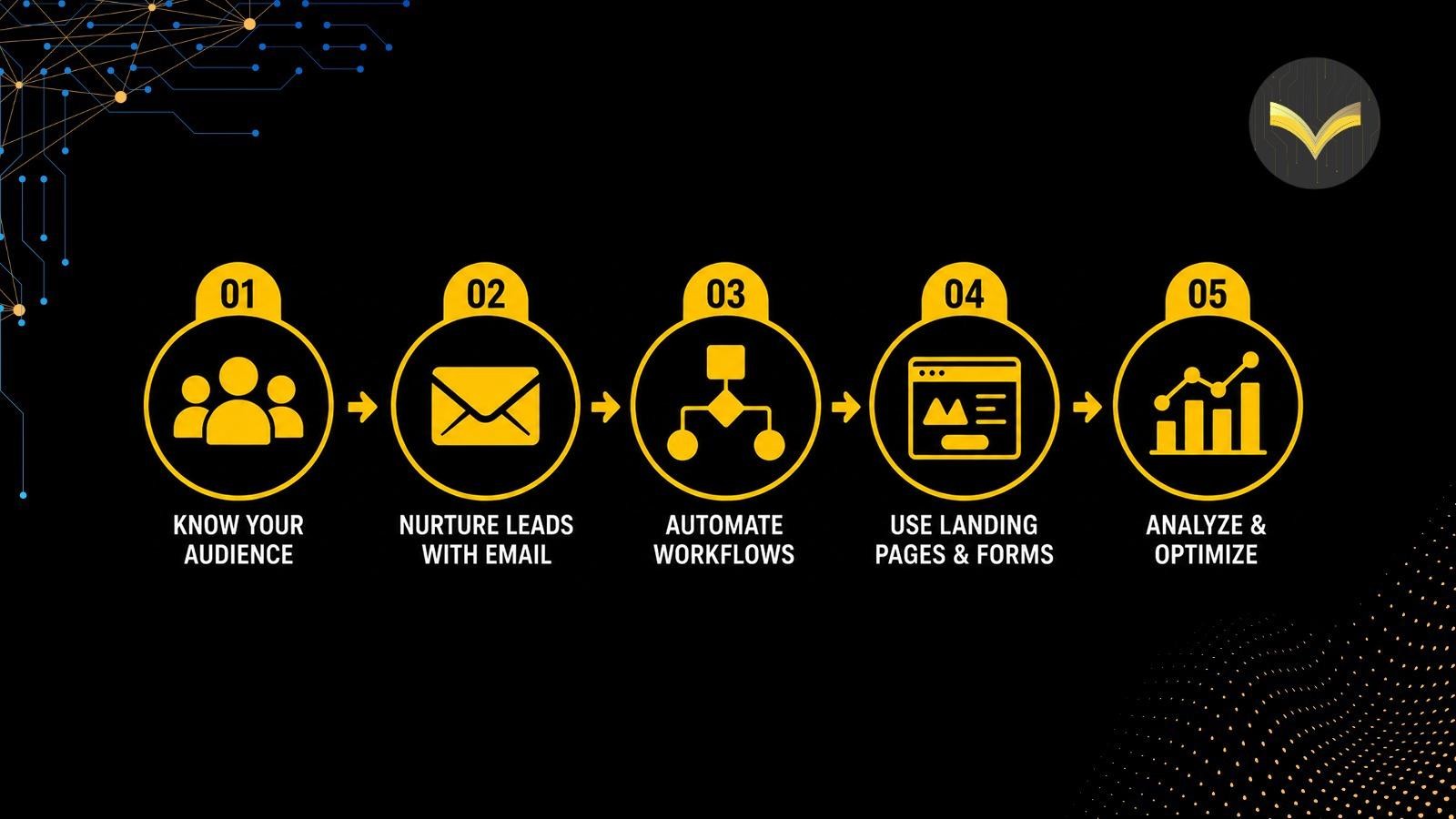
Marketing Automation Strategies to Increase Leads and Sales
All companies have a desire to attract customers without the need for consuming time on tedious marketing functions. As companies become larger, there becomes a larger burden to manage email campaigns, handle aspects of social media, perform lead nurturing, and conduct follow-ups. Luckily, there is the option of marketing automation.
Marketing automation tackles the burden of the time-consuming tasks that are tedious and repetitive. Companies have the ability to engage those who they want to target at the ideal time, automate and personalize their marketing, and streamline the movement of potential customers to the sales funnel. Automation does not eliminate the need for creative marketing; it allows companies to devote their efforts to strategy, innovative ideas, and engagement with potential customers.
It does not matter if your company is a new venture, an online sales company, or one carrying out large business operations; the proper automation can help you maximize your sales and the number of customers you serve.
What Is Marketing Automation?
"Marketing automation" is the term that refers to the technology that helps companies automate the repetitive and time-consuming functions of marketing, such as email campaigns, marketing to specific segments of the audience, scoring leads, and follow-up.
Marketing automation platforms do not require a company to individually reach out to prospects. Marketing automation is a tool that is utilized to create a response based on the behavior of the potential customer. Suppose a prospect downloaded a free eBook; marketing automation platforms have the ability to send a thank you email and a series of educational and sales emails in subsequent days.
Aside from the ease and time-saving capability of automation, it also generates a great deal of data regarding the behaviors of potential customers. This facilitates a company's fine-tuning its marketing campaigns to improve sales.
Why Marketing Automation is Important for Business Growth
Being the first company to respond to customer action often results in a competitive advantage. Automation allows businesses to keep in touch with prospects 24/7 without the need for constant manual work.
This also eliminates human error and identical experiences across all marketing channels. Automated workflows, from welcome messages to abandoned cart notifications, ensure no opportunity is missed.
Some benefits of this include:
- Greater lead nurturing
- Increased customer engagement
- Increased conversion rates
- Less manual work
- Increased communication personalization
- Increased speed of responses
- Improved analytic tracking and performance of campaigns
How Marketing Automation Leads to More Sales
The difficult part after gaining leads is selling to them. However, this is not a challenge for automation.
Automation is perfect for the collection and education of leads via digital forms, gated content, webinars, and email sequences. Automated systems can score leads and prioritize them based on their content engagement.
Sales teams can then target their efforts on the leads that matter.
What are some lead-nurturing strategies that run on automation?
Although the name "automated systems" insinuates a lack of a personal touch, a well-thought-out automation system can provide timely and valuable touch points relative to the customer's position in the buying cycle.
Some of these touch points can be informative articles, user guides, and success stories. These serve to build rapport and not bombard the potential buyer with offers.
Welcome email series
- Educational newsletters
- Download follow-up campaigns
- Product recommendation emails
- Event reminders
- Customer onboarding sequences
- Inactive user re-engagement campaigns
The Sales Impact of Email Marketing Automation
Particularly when paired with automation, email marketing is one of the most effective channels of digital marketing. Rather than sending out a bulk communication, automated email marketing enables the sending of triggered emails.
These emails, in contrast to bulk communications, contain information, messages, and offers that are relevant to the recipient. For example, if one customer leaves an online shopping cart, that customer may be persuaded to finish their purchase if their shopping cart email is sent. Alternatively, an email that is automatically sent after a purchase may suggest other products that are related to the purchase, or it may even contain a satisfaction survey.
Automated email marketing is a great way to retain customers and increase your business' revenue.
The Impact of Customer Segmentation on Marketing Automation
Customer needs and their corresponding buying behaviors are not uniform. The segmentation of customers enables tailored messaging that resonates with a buying segment.
Automation is able to differentiate customers based on their demographics, geographic information, and even the level of their engagement. With this information, refined offers and related recommendations can be made.
More often than not, marketing segmentation that is automated leads to greater customer engagement and improved conversion rates.
The Purpose of Lead Scoring in Marketing Automation
Lead scoring is a system that ranks customers based on their level of engagement and the buying behavior that is demonstrated through their actions.
Read on to find how sharper scoring improves sales performance
Disparate activities are all reflected in a performance score, which changes in real time. Once your score hits a certain level, sales reps are notified and are able to engage with you.
Engaging with leads that are ready to buy helps to make the overall sales process quicker.
Multi-Channel Marketing Automation
Buying behavior has changed and consumers now have multiple points of interaction on their purchasing journey. They may discover your brand on social media, sign up to your emails, browse your products on their mobile device and make their purchase on your desktop site.
A marketing automation strategy allows you to communicate to your consumers on all points of interaction.
Some of the most common automated channels are
- Email Marketing
- SMS Campaigns
- Social Media Posts
- Push Notifications
- Website Chat
- Personalized Website Content
- CRM Automation
Connecting all these channels helps to make the buying process smooth and easy and encourages your customers to buy from you again.
Personalization
Personalization means different things to different people. Automation takes it to the next level, allowing enterprises to tailor their site to their customers, including offers, promotions, and communications.
For example, returning customers can have their promotions formed around their past purchases, whereas new customers are sent promotional and informational content geared towards being a first time buyer. Furthermore, a site can change what it displays and offers based on the browsing history of a given user.
This degree of personalization results in higher engagement and conversions.
Analytics and Continuous Optimization: The Key to Greater Campaign Success
The first step is the launch of automated workflows. The second step is the analysis of the campaigns to ensure the workflows are consistently producing results.
When analyzing campaigns, marketers should consider the following:
- The rate at which emails are opened
- The rate at which links are clicked
- The rate at which recipients take the desired action
- The cost of acquiring a customer
- The revenue impact
- The quality of the leads
- The rate at which the workflows are completed
With consideration for these metrics, campaigns can be optimized for performance and improved for the future.
What Common Mistakes Must Be Avoided by Businesses?
The pitfalls of automation must be avoided despite the advantages of automation. An over reliance on automation can cause a lack of personalization, which can depress customer engagement.
They also must avoid:
- Too many emails
- Lack of audience segmentation
- Outdated workflows
Regularly updating automation is required to ensure the workflows are relevant and beneficial.
Finally, complete reliance on automation can result in the loss of customer engagement opportunities.
What is the formula for a successful marketing automation strategy?
Successful marketing automation relies on the knowledge of customer behaviors and the goals of the business. Each marketing automated workflow must be goal-oriented.
Successful strategies must include the following:
- Marketing goals are established.
- The customer journey is mapped.
- Effective audience segmentation is done.
- Automated workflows are built.
- Integration of CRM and analytics is done.
- Performance is assessed.
- Campaigns are optimized.
- Customer feedback is used to refine the message.
Marketing automation focuses on the generation of leads, the retention of customers, and the growth of sales.
Closing Remarks
Working smarter is the new working harder. Marketing automation gives companies the opportunity to put in the time to create personalized and punctual experiences for customers without the manual labor.
With the appropriate strategies in place, automation can help a company develop better leads, enhance customer relationships, optimize efficiency, and boost profit. Continuous thoughtful planning allows every company, large or small, to establish marketing frameworks that are adaptable and allow the company to grow and become a leader in the industry.
FAQs
What is marketing automation?
This combines all the functions that a company needs to keep current customers and gain leads, such as customer segmentation, nurturing leads, and emailing, and does them for the company.
What is the advantage of marketing automation?
This helps a company gain leads faster that are at a higher quality for the company, helps the company grow without adding a larger workforce, and gives the customers different experiences.
Does marketing automation help smaller companies?
Absolutely. Smaller companies can more easily engage with customers and gain leads without adding more employees and competing against larger companies in the industry.
How does marketing automation help companies gain customers and profit?
This helps keep communication with customers and leads, grows engagement, and does it in an optimal way at a larger scale.
Is marketing automation just a way to email customers?
No, this also helps with talking to customers and prospects through social media, SMS, and a company's website. It also helps with tracking leads and giving a company metrics.
How often should automated campaigns be reviewed?
Companies should review their automated processes and metrics at least once a quarter. This helps the company keep the automation optimal and assist the customers in the best way.